Dianna Ogle and Jess Maihi-
Lesson time model from Japan- what the timing of the lessons look like.
Dianna Ogle and Jess Maihi-
Lesson time model from Japan- what the timing of the lessons look like.
T Shaped Literacy- Shared reading.
Shared reading:
Can be used with small or large groups
Teacher support enables students to access and make meaning of challenging text, even if they are not able to read the text “comfortable on their own”.
Allows for a high level of interaction between students and teachers, and promotes conversation about texts.
Provides multiple instructional opportunities - specific strategies, vocabulary, understanding of text forms and structures, critical responses
Exposes students to a wider range of texts
Is not choral reading!
The teacher and students all read the text together. All students need to be able to see the text.
With a shared approach the teacher reads the text aloud, while students read the same with the teacher. In junior classrooms, students will often join in reading of key parts of the text, or the entire text, to develop fluency and expression (not to make meaning). In senior classrooms the text is read silently by students.
A wide range of texts can be used - fiction, non-fiction, electronic texts, posters, charts…
Texts should be chosen to meet specific learning goals, and with a T-Shaped Literacy approach, they should also relate to the big idea, or learning context, being explored.
Junior Y1-4
Introduce the text
Make links or connections to what they know, and other texts they have read.
First reading focus on enjoyment and understanding of the text.
Subsequent Readings
Focus on specific learning - vocabulary, spelling, phonics, structure of text, sentences, key themes and ideas…
Response to Reading/ Follow Up
Writing or Shared Writing
Retelling
The Arts - Drama, Visual Art…
MK data: use this data to support our class program
What can we do to make an impact:

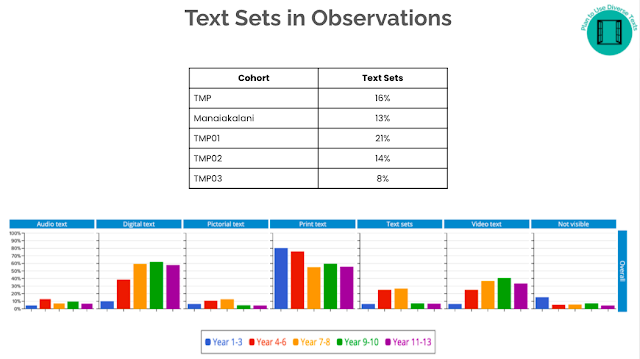

Are we choosing diverse texts that are culturally responsive to our learners?
Selecting texts for our learners- are our students feeling connected to the texts we are selecting, do they see themselves within a text/feeling worthy because they are represented in a text, but still opens up their imagination. Think about the multiple personalities students have.
Questioning:
Literal questions is good, need to work on open ended questions a bit more, extended discussion (not lead by teacher) needs improvement.
Need to plan the high order questions otherwise they won't get asked/discussed - this needs to be purposeful.
Difference between discussion and questioning-
Extended discussion - needs to go around the children not back and forward to the teacher. Teaching the children to have these discussions and to listen to each other so they can add to the discussions.
Students have a discussion example: https://www.youtube.com/watch?v=2ADAY9AQm54


Increase student engagement:

Sharing learning- we need to increase how much our students get to share - blogging needs to connect to reading create tasks more, this can also be more in person sharing.
Readings of interest:
Almarode, J., Hattie, J., Fisher, D., & Frey, N. (2021). Rebounding and reinvesting. Where the evidence points for accelerating learning. A GOLD paper. Thousand Oaks, CA: Corwin. Retrieved from: https://us.corwin.com/ en-us/nam/white-paper-reinvesting-and-rebounding
Text analysis and finding evidence in text:https://nmssa.otago.ac.nz/insights/INSIGHTS_English_Making_Meaning_2019.pdf
Multimodal text and critical literacy:https://nmssa.otago.ac.nz/insights/INSIGHTS_English_Multimodal_2019.pdf
Oracy in the Classroom:https://www.youtube.com/watch?v=2ADAY9AQm54
Disciplinary Literacy:https://c3teachers.org/wp-content/uploads/2016/09/Shanahan_Shanahan.pdf
Manaiakalani innovative teachers presentations:
Using Mote on google slides to explain what they need to do.
https://sarahtuiapb.blogspot.com/search/label/MIT2021
http://rebeccahenderson6.blogspot.com/search/label/MIT2021
In term 3 of 2021 we went into a very sudden Level 4 lockdown.
During this time we had to teach online and have learning accessible through our class site for all of our students.
On this site there were learning activities for reading, writing, maths, health and PE, art and inquiry. Students had access to all the learning and could chose what tasks they wanted to do. They could then share their learning on their blogs or via email to me.
Students were able to use their devices from school during this time and any students that were unable to use a device at home were given hard packs with a variety of learning activities in them made by their teacher.

Reflection of home learning:
Students really enjoyed the online sessions and liked to catch up. Most of the students that were on the online meets were sharing there learning back to me. Students loved seeing comments on their blogs by others so this was added as a CAN DO task. The half an hour online meet time was more than enough time for the children. We go to do 2-3 activities every time we met online. The kids really enjoyed doing Kahoot quizzes which was really fun. I would continue with this same layout if we went into lockdown again as it really worked for the children that were online.

